

China’s Chip cities
Where China’s Domestic Chip Industry Is Taking Shape

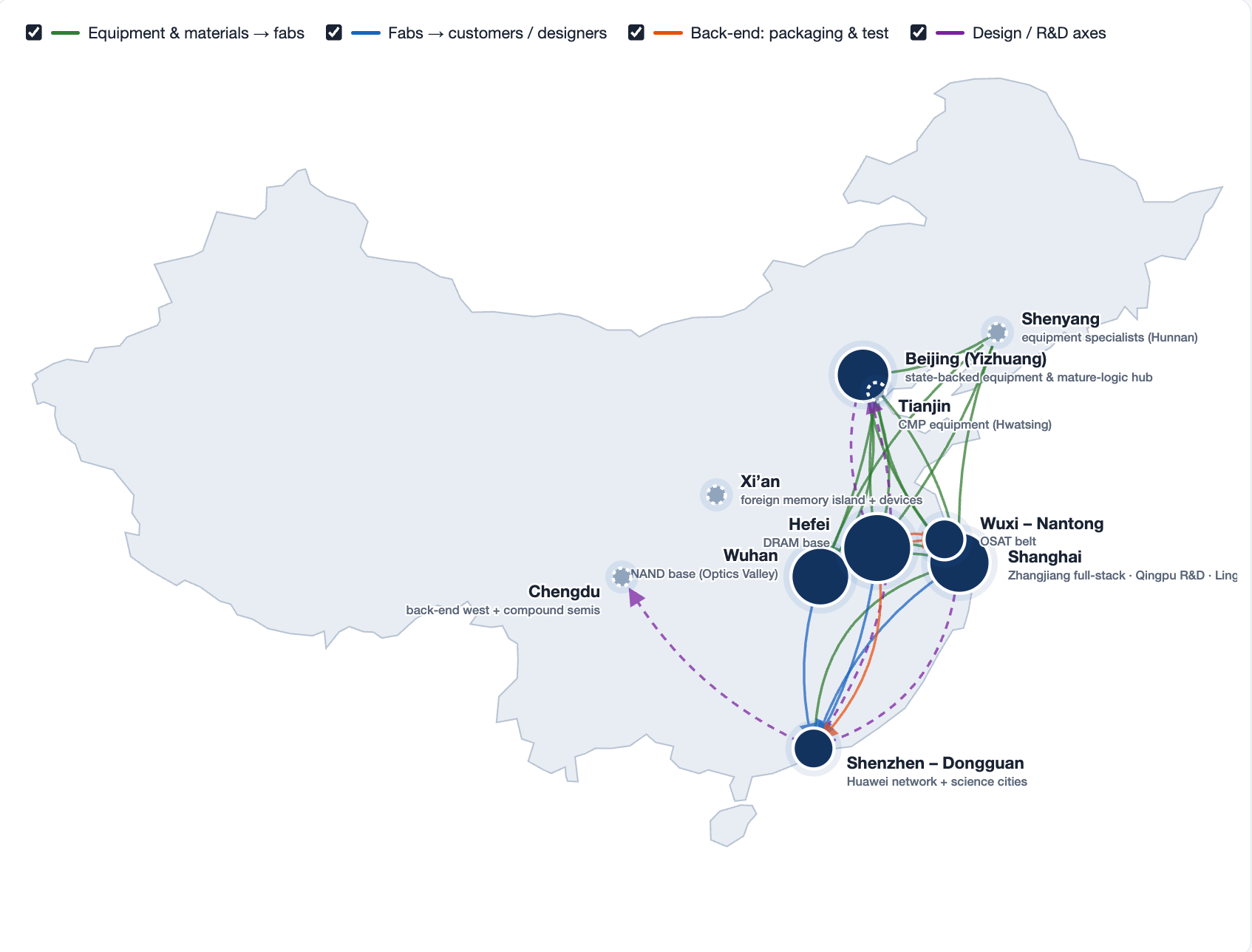
China is not merely constructing a few national champion semiconductor firms, but several geographically rooted production systems. This report examines who is building them, how they are financed, and what each region reveals about China’s attempt to reproduce one of the world’s most complex industrial ecosystems.
This week, the Wall Street Journal published a report detailing developments in China’s efforts to develop advanced chips that may one day allow China to wean its dependence on ASML and Nvidia. Xi confidant Ding Xuexiang heads a so-called “Chip Committee” to oversee the effort, which got off to a rocky start. Last year, Huawei released its Ascend 950, which showed promise. China is requiring companies to apply for waivers to require purchases of Nvidia chips even after Jensen Huang ate Beijing Street food on a charm offensive during Trump’s recent visit to Beijing. Still, the gaps are substantial: Nvidia’s top AI chips still boast around four times the computing power of Huawei’s best Ascend offering.1
China’s push to make its own advanced chips is usually described as a national project. But it is being built in specific places, by different kinds of organizations, under arrangements that vary enormously. China’s indigenous semiconductor push is occurring primarily in three places: the Shenzhen–Dongguan corridor, Shanghai’s Zhangjiang Science city, and Beijing’s Yizhuang Economic and Technological Development Zone. Additionally, inland Wuhan and Hefei are centers for China’s burgeoning memory chip industry, Hefei’s fortunes boosted after the recent IPO of CXMT made it China’s most valuable listed company.
View interactive Map of China’s semiconductor production bases
As Chris Miller has detailed in Chip War, the global semiconductor industry is dispersed across various companies around the world—but in key processes and technologies the ecosystem is highly dependent on one or two companies. ASML in the Netherlands has a virtual monopoly on the production of advanced EUV machines needed to make the most advanced chips. Taiwan-based TSMC is the world’s leading foundry—the production base where chips are made. China, increasingly shut off of the world’s leading chips by U.S. export controls, is trying to get around the restrictions by doing what it always does—doubling down on an all-out state-led effort involving central funding, local competition, and investment in basic research to assist the capital investment of individual companies.
This post explores the places, companies, and ecosystems where China’s indigenous chip effort are happening.
Where China’s Domestic Chip Industry Is Taking Shape
China’s effort to build an independent semiconductor industry is often described as a single national project. On the ground, however, it is taking shape through several distinct regional ecosystems—each with its own companies, government investors, research institutions, and industrial strategy.
The most important clusters are emerging in five places:
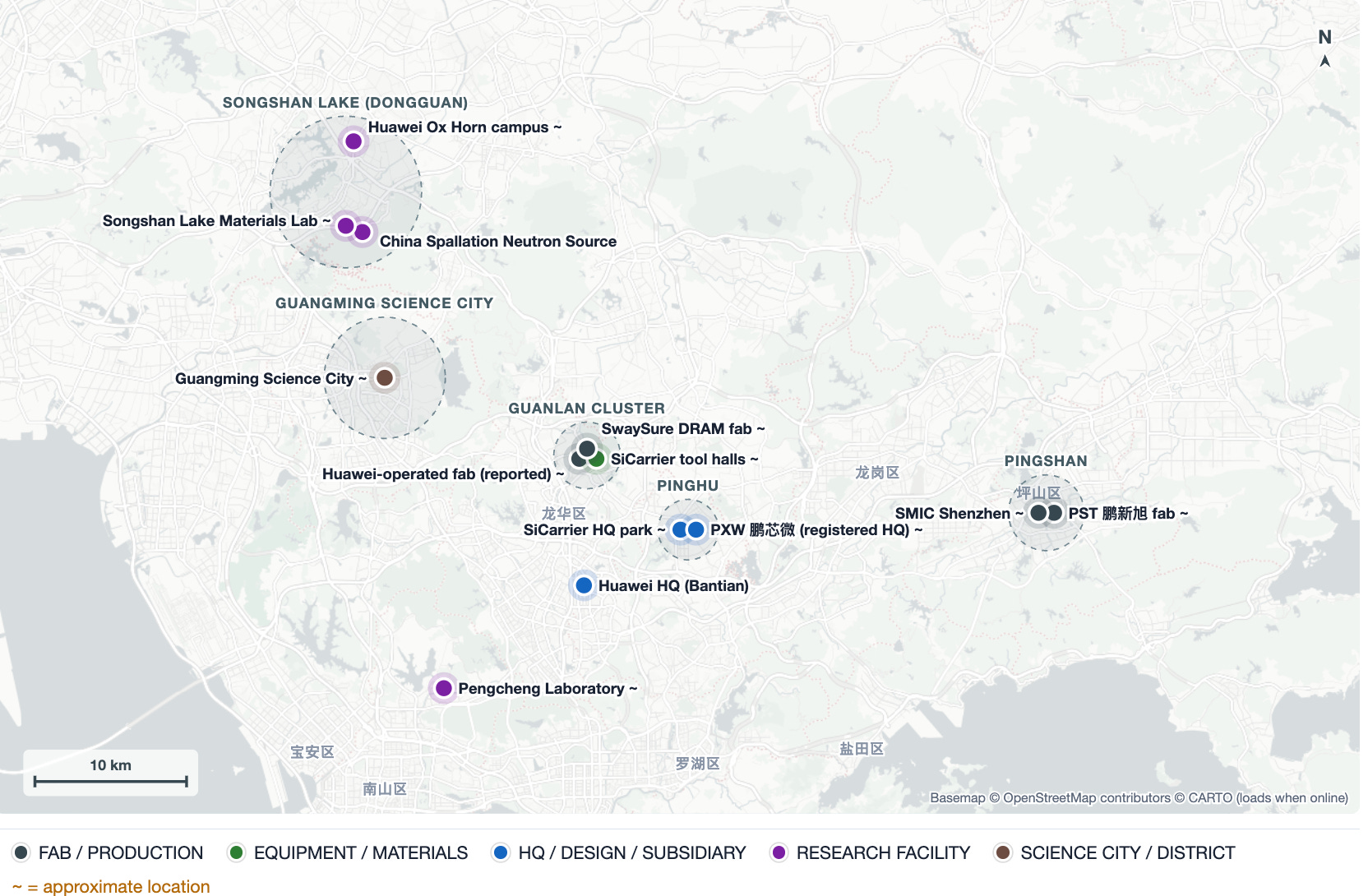
Shenzhen and Dongguan, where Huawei sits at the center of a closely integrated network of fabrication plants, semiconductor-equipment companies, computing infrastructure, and scientific facilities.
Shanghai’s Zhangjiang Science City, China’s most complete commercial semiconductor ecosystem, spanning chip design, foundries, manufacturing equipment, materials, and capital markets.
Beijing’s Yizhuang development zone, a major base for semiconductor equipment and mature-node manufacturing, supported by Beijing’s municipal investment institutions. China Academy of Sciences and Tsinghua University are an anchor for research in the city’s northwest, home to new AI chip designer Cambricon
Wuhan, where the state-backed National Memory Base and YMTC anchor China’s NAND flash industry.
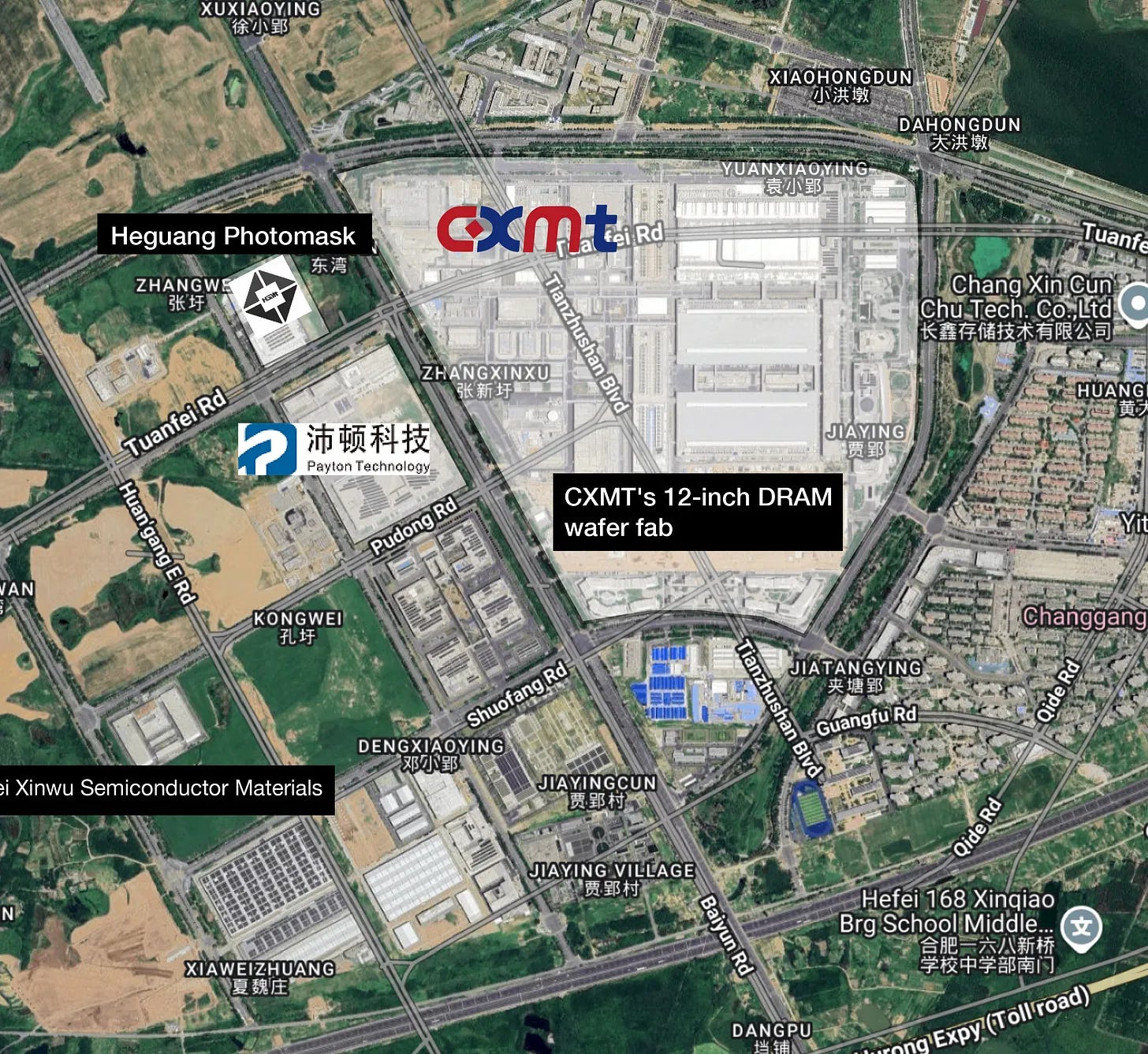
Hefei, whose locally cultivated CXMT ecosystem has become China’s principal center for DRAM production.
Together, these places reveal how China’s semiconductor campaign actually works. Central policy supplies strategic direction, but municipal governments assemble much of the industry: they provide land, finance fabrication plants, create investment vehicles, establish research facilities, and recruit companies into geographically concentrated supply chains.
The resulting model differs from one city to another.
Shanghai has the deepest market ecosystem, with competing chip designers and publicly listed equipment companies—but its advanced designers still depend on scarce manufacturing capacity at SMIC. Beijing is building on decades of state-owned electronics manufacturing and a strong network of equipment companies and Chinese Academy of Sciences institutes. Wuhan pursued a top-down national megaproject centered on NAND memory. Hefei used patient municipal capital and industrial partnerships to cultivate a DRAM producer after losing the competition to host the original national memory base.
The Shenzhen–Dongguan corridor represents perhaps the most unusual model. Huawei provides technical direction and demand, while state-owned investment platforms hold many of the facilities and companies involved. This arrangement has helped create a network of legally distinct but physically proximate fabrication plants, equipment suppliers, laboratories, and computing centers. It is both an industrial cluster and a large-scale testing ground for domestically produced semiconductor technology.
If you want to know who runs SiCarrier 新凯来, the semiconductor equipment company that has become central to China’s attempt to build its own chip tools, the Chinese corporate registry is not much help. It will tell you the firm is wholly owned by Shenzhen Major Industry Investment Group, a municipal-owned investment platform. For the answer most people in the industry believe, you have to consult the U.S. Department of Commerce, which lists among SiCarrier’s aliases as: Huawei Starlight Engineering Department. The Financial Times reported that Huawei is believed to operate one of them for 7nm production — Kirin mobile chips and Ascend AI processors — with SiCarrier and the memory startup SwaySure running the others.
China has not eliminated its dependence on foreign semiconductor technology. It remains constrained by lithography, advanced manufacturing capacity, specialized materials, and the performance gap between its leading AI chips and those available internationally. But looking only at national funding totals—or at individual champions such as Huawei and SMIC—misses a crucial part of the story.
China is constructing not merely a collection of semiconductor companies, but several geographically rooted production systems. The rest of this report examines who is building them, how they are financed, and what each region reveals about China’s attempt to reproduce one of the world’s most complex industrial ecosystems.
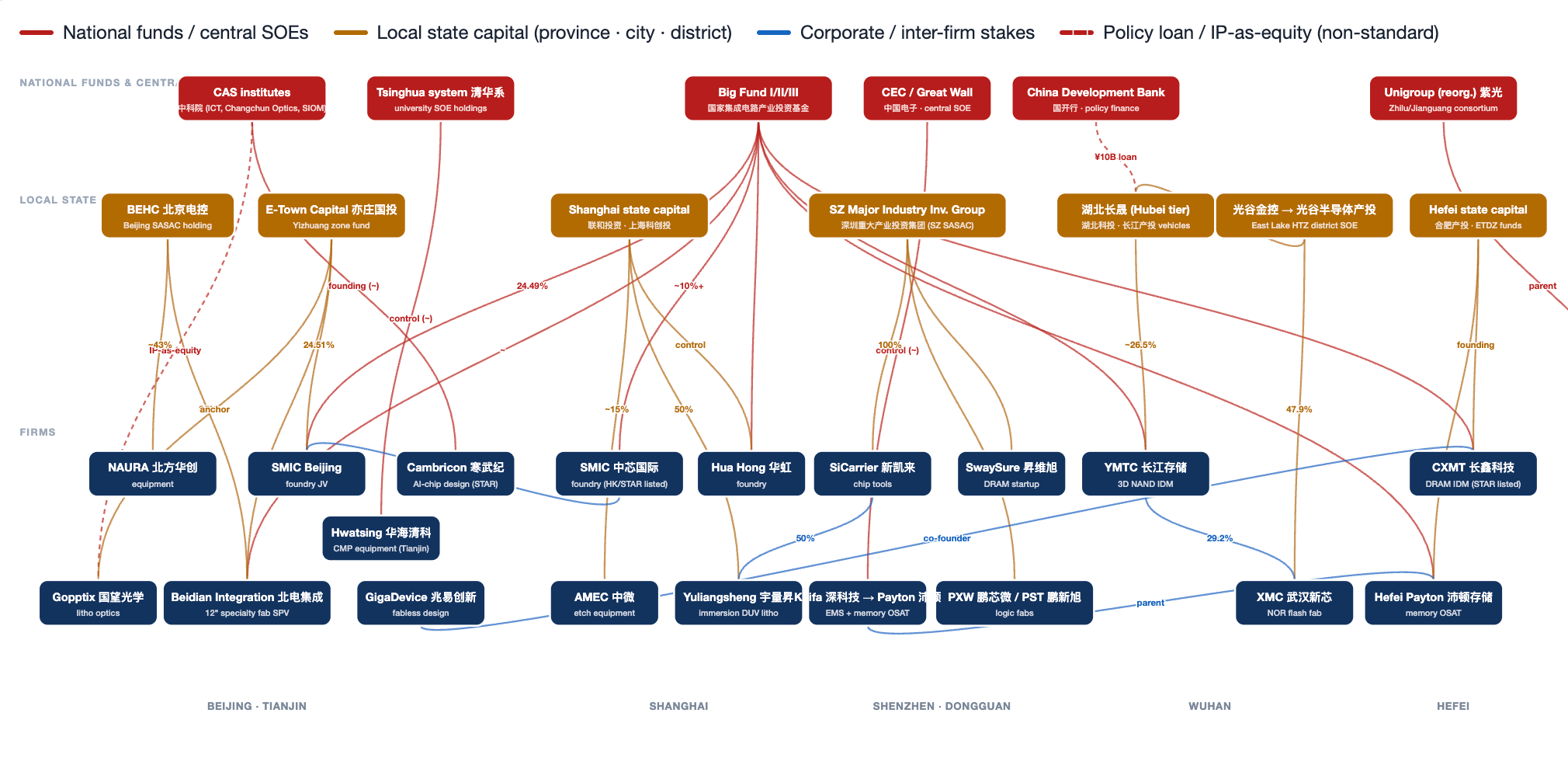
View interactive graphic of China’s semiconductor ownership
For paid subscribers: A detailed tour of the five regional clusters driving China’s semiconductor campaign, including:
the relationship among Huawei, SiCarrier, and Shenzhen’s municipal investment system;
how Shanghai combines chip design, fabrication, equipment, research, and capital markets;
Beijing’s state-backed semiconductor-equipment network;
the contrasting paths Wuhan and Hefei took into memory-chip production; and
the research campuses, fabs, government funds, and corporate structures tying these ecosystems together.
