

The "Low trust-Open Source" Paradox of AI Adoption in China:
The reasons China has turned to open source AI are not the ones people usually mention


A central paradox is that China’s embrace of Open Source AI is directly related to a deep-seated and pervasive lack of trust in data security of cloud and AI cloud platforms.
The “Low Trust-Open Source” Paradox of Ai Adoption in China
My research has focused mostly on the infrastructure underpinning AI—data centers, energy, and the application of AI in governance (smart cities) and other infrastructural sectors. Over the last month in China, I had the chance to talk to a number of AI founders and those in China’s cloud companies and public sectors. One of the themes that kept coming up was how lack of trust in data security hinders cloud enterprise adoption, as well as AI enterprise use. This is hard to square with China’s headlong embrace of all things AI. Since the emergence of Deep Seek in early 2025 as an open source rival to leading US AI models, China is sometimes seen to be following a different path that favors “open source” rather than the proprietary enterprise subscription models of Google’s Gemini, Claude, and OpenAi. By many measures, China’s open source models (DeepSeek, Kimi, Moonshot, Zhipu) are more widely used around the world, and even increasingly in the U.S.1 But from a commercial standpoint, AI business models are more mature and already generating far more revenue for U.S. based cloud companies than their Chinese platform counterparts.
The distinction between the U.S. and Chinese AI paths is real. But, a lot of recent commentary on China’s AI ecosystem suggests that China’s “open source” approach arises out of farsighted government promotion of industry adoption and public benefit or high-minded virtues of openness that supposedly contrasts with a proprietary high-fence approach of leading Western cloud and AI platforms. However this narrative greatly oversimplifies actual business dynamics in China. For one, while Deep Seek itself may have developed a culture of research and open source, China’s broader business ecosystem is characterized by mistrust and lack of confidence in data security and data property rights. 2 A central paradox is that China’s embrace of Open Source AI is directly related to a deep-seated and pervasive lack of trust in data security of cloud and AI cloud platforms.
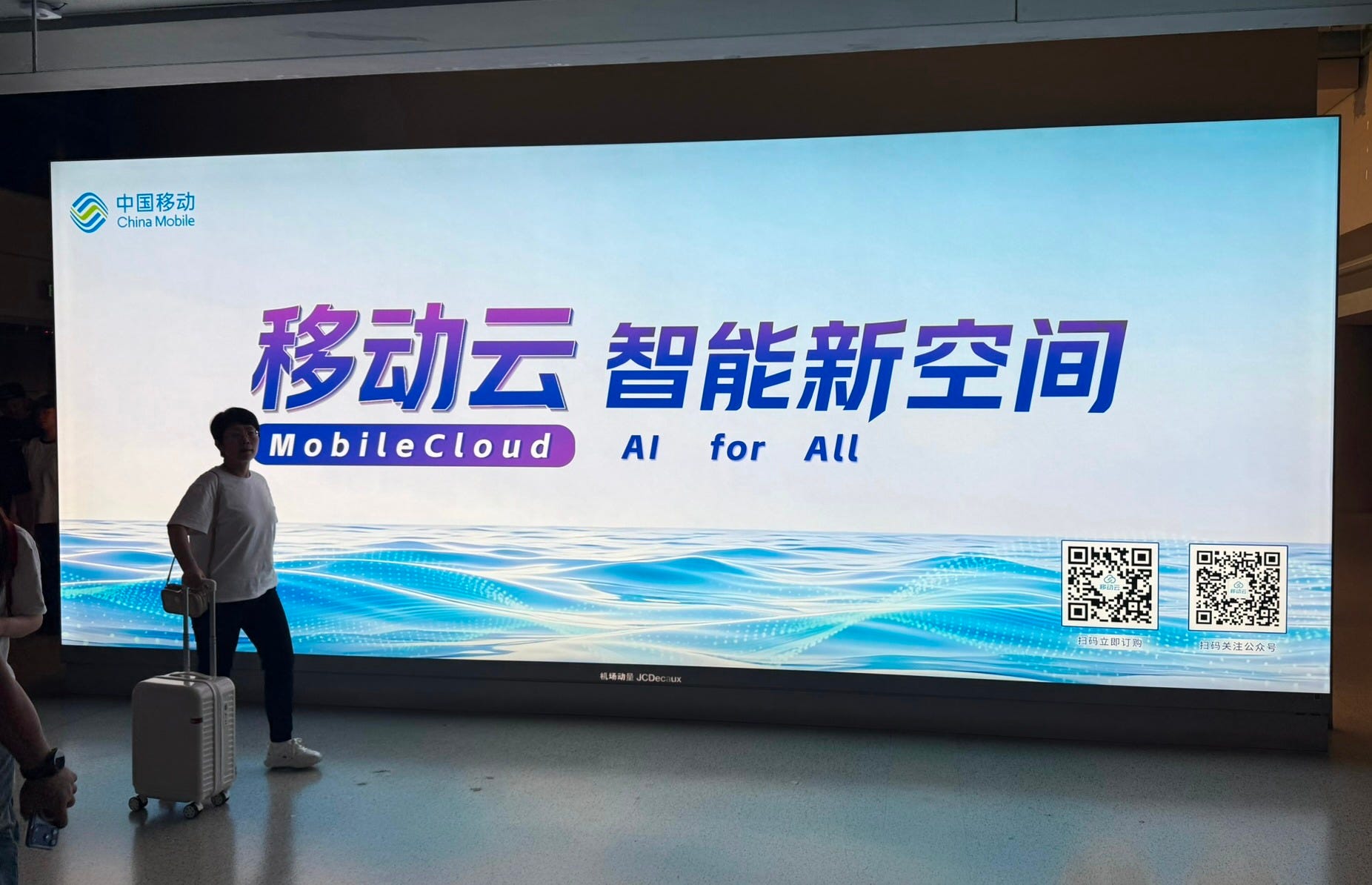
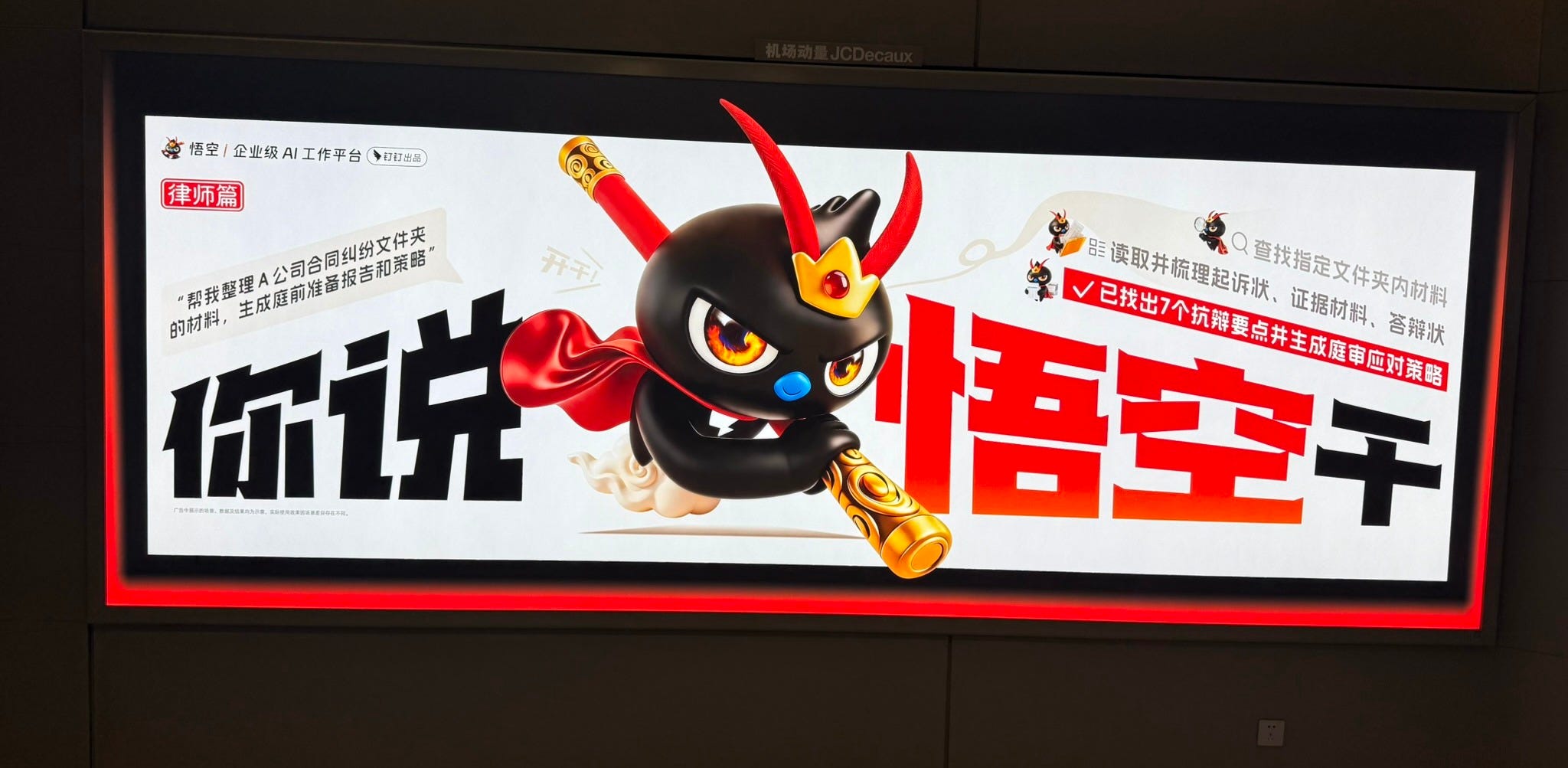
By many measures, China is seeing massive embrace of AI. Nearly all professionals I spoke to were using AI, many using American models via VPN. Airports are blanketed with floor to ceiling ads of leading AI companies, stores sell Ai-enabled glasses (Rokid), AI-enabled pets, and AI-enabled (you name it). When talking about enterprise policy at their companies, nearly people I spoke with said their companies generally prohibit putting any private corporate data or operational data into cloud AI systems—either American or domestic. The preferred approach is to deploy internal AI systems “on premises” neibu bushu 内部部署., which are seen to be more secure. I spoke with the founder of an AI company focused on medical imaging technology (infared) in Shanghai whose cofounder had apparently bought Nvidia chips many years ago and had set up server racks in the company’s headquarters. Many also continue to use VPNs to access Chat GPT and Claude as they are still seen to be superior to Chinese models especially for complex tasks and work.
The divergence between U.S. and Chinese AI ecosystems starts with the basic fact that enterprise cloud adoption in China lags the U.S by a wide margin both for demand and supply deficits, as JS Tan has analyzed here.3 The reasons for this are multifaceted. Chinese companies have lower willingness to pay for recurring subscription-based SaaS services, as is common in many sectors of U.S. business landscape. Sure, China has several leading cloud providers: Ali Cloud, Tencent, Baidu, as well as state-owned offerings from China Telecom and China Mobile that are mostly geared towards government agencies and state-owned enterprises. But another significant reason has to do with a lack of trust, and a lack of enforcement (or a lack of faith in that enforcement) of private property rights, which extends to data ownership rights.
“Trust in the Chinese market is low. In many situations contracts are not seriously enforced, and everyone seems to know that data leakage and privacy issues are huge in general.”
—-manager at one of China’s leading third-party cloud firms
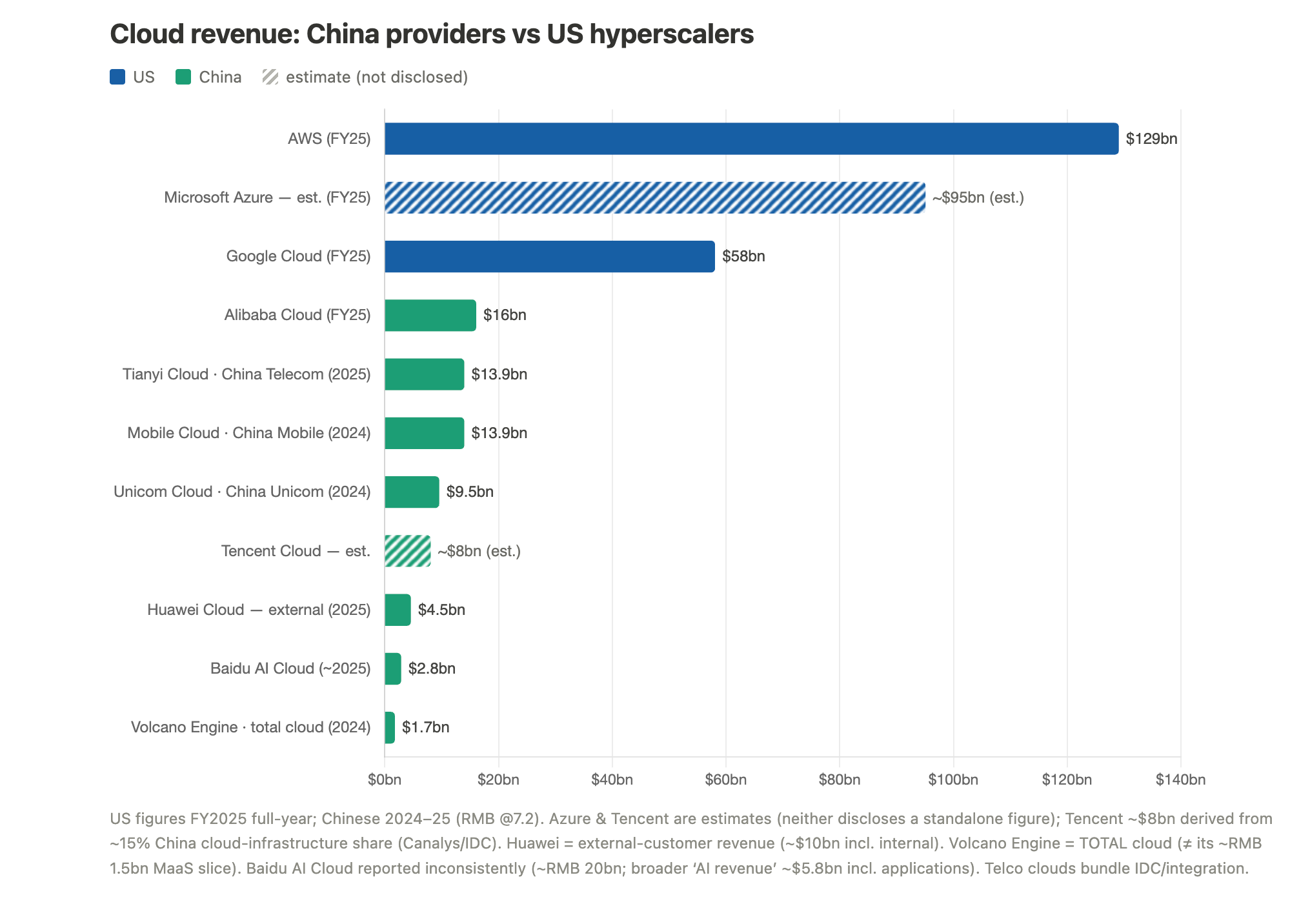
A Shanghai-based employee of an AI startup that is implementing AI in monitoring operations for their company said their managers prevent them from putting any corporate data directly on AI cloud platforms—of either U.S. or Chinese cloud platforms. Employees of larger corporates are generally encouraged to use AI models and cloud platforms within the corporate group. For example, employees of Alibaba use Alicloud, Xiaomi relying on Kingsoft Cloud (owned by Xiaomi Group), Baidu companies use Baidu cloud or Meituan using its own internal model. Many also mentioned the strengths and limitations of some of these models. Meituan’s model is widely seen to be inferior to others but they are encouraged to use it for their own internal operations. The “open source” approach to AI LLM adoption is paradoxically driven by a preference for internally closed data systems.
While trust is one motivation for open source, cost is probably the most important reason. “I think people open source simply because of [neijuan] involution,” my friend working for a cloud company told me. “They cut price for that too, just look at Deep seek and Xiaomi Mimo—Both aimed at gaining market share for longer term gain. Then of course it just so happens that these open source models can be easily deployed privately in private environments.”
Challenge of Data Integration for AI
Discussions of China’s unique approach to AI tend to suggest China is laser-focused on diffusion and enterprise adoption. In 2025, it released the AI+ Policy (an AI update to its 2015 “Internet Plus” Vision), that calls for embedding artificial intelligence across every layer of the economy and society to drive a new era of productivity. Indeed China’s policymakers are focused on diffusing AI and leveraging its benefits for broader economic growth across many industries. But there is a continued challenge of data integration that stems from the same lack of trust in data privacy and property rights that has hindered broader cloud enterprise adoption. Over the past few years, national agencies have unveiled a series of initiatives to promote “data circulation” shuju liutong, the elimination of “data islands” shuju qundao, and the focus on data as a key “new factor of production” or new quality productive forces. Whatever term used, the idea was that data needs to be aggregated and shared in order to realize its full value. In 2023, the National Data Administration was set up, and several cities (including Shanghai, Hangzhou, Suzhou, and Shenzhen) have set up data exchanges where companies are supposed to be able to trade and exchange data. Some of these have focused on data sets needed for Ai model training. But almost all people I spoke with laughed at these policy experiments. “The government puts out policies for things that are the opposite of the reality on the ground. It’s a vision, not reality.” Most of these government or city-backed exchanges see paltry volumes of data actually traded on their “Exchanges.”4 Many people in the industry I spoke to note how companies are hesitant to put their valuable data sets on exchanges, fearing government regulation or theft by competitors. Most companies prefer to buy proprietary training data sets, which as has been shown, often relies on exploitative low-wage human data-labelling enterprises.5
But beyond these mostly political data trading showcases, there is a deeper question of how a lack of trust in data security or data rights actually impacts the development of AI in China. Nothing is stopping Chinese companies from deploying open source models in on-prem servers to help optimize their operations or perform complex tasks. But the lack of serious cloud adoption could hinder some of the economies of scale that come from the aggregation of huge amounts of data on hyperscale cloud platforms. Arguably its the U.S. hyperscalers who stand to benefit the most from AI adoption in the West as companies already using the cloud add on advanced AI tools and services to their existing subscriptions. Cloud companies benefit from lock-in and network effects, where cost of switching providers gives incumbents significant power to lock in existing customers and sell them new Ai services. In China, we do see some uptick in enterprise AI adoption. But the path still seems to favor a more piecemeal approach, where keeping data within secured “data lakes” (either within government agencies or within companies) is paramount. This actually directly contradicts the vision from national agencies and regulators for “free flowing data factors” and aggregation seen in recent initiatives from the 2023 Plan for Building a Digital China to 2025 AI+.
Security first, pay later: SOE/Government procurement
At a state-owned municipal engineering institute I visited in Shanghai, the head of a unit that previously focused on underground tunnel engineering is developing a platform for agentic infrastructure for smart cities, hoping to deploy the service to help automate workflows within city infrastructural management, something long dreamed of in smart city projects. He acknowledged how many of these smart city projects had created pretty but useless dashboards with no function. But with the rise of agents, or zhineng ti 智能体, such data dashboards would not have to rely on one person monitoring information but rather multiple agents processing data, dispatching services, and making decisions. The firm was developing a system for using this to manage trash collection from waste bins across all of Shanghai.
State-owned enterprises are even more wary of putting their data and or corporate processes into proprietary AI cloud environments, and are being encouraged to work with cloud services of major telecoms like China Unicom, China Telecom and China Mobile. But these platforms are widely seen to be lagging behind the private cloud players in terms of technical capacity and sophistication. Huawei, while not formally an SOE, is basically seen to be on the “national team” due to its close military and Party associations. Huawei is thus poised to deploy its AI ecosystem for the public sector and SOE clients. For state-owned enterprises, the focus on data security is even more front of mind. As a friend put it, “SOEs have natural tendency for higher security requirements and doesn’t care that much about cost - they don’t think economically, more politically.”
The relationship of state or government contracts (procurement) for AI enterprise adoption presents an interesting tension. A friend in the industry in Shanghai told me that Sensetime 商汤, which is a partially state-owned Shanghai/Hong Kong based and HK- listed firm in computer vision and facial recognition tech has been declining even as they were described quite recently as “the world’s most valuable AI startup.”6 Their model is not keeping up, and taking on government contracts has been bogging them down. Their facial recognition tech is widely desired for China’s police and national surveillance apparatus. But there is a widespread feeling among industry professionals that government contracts can be both a blessing and a curse for companies. An AI founder in Shanghai told me bluntly “governments are the worst clients, they never pay on time and they keep asking you for more resources and more work.” This echoes much of the research I have done on the exit of private platform firms from the Smart Cities sector. For example, Alibaba helped develop Hangzhou’s City Brain platform which became a model for China’s smart cities nationwide—but the firm laid off most of its smart cities staff and closed its division a few years ago. As a former Ali cloud engineer told me back in 2024, “the government looks at the salaries of big tech engineers and they scoff—why do we need to pay you that much? Why can you just devote more human resources to the project?” Cash-strapped local governments are eager to get contracts for AI on the cheap, but this can suck resources and energy out of companies while failing to deliver solid revenue streams.
“the government looks at the salaries of big tech engineers and they scoff—why do we need to pay you that much? Why can you just devote more “human resources” to our project?”
—Former Alicloud Engineer
Low-Trust, High innovation or AI Involution?
We don’t yet know how this “low trust open source” approach will play out. Despite the pervasive lack of trust of private property/data rights, China’s AI ecosystem is hardly stagnating. The lack of trust in data security may hinder adoption of cloud and enterprise AI services, but it has not hindered diffusion of AI models for deployment within company processes or “on-prem” services. Still, this paradox has important implications for the political economy of AI in China. If leading cloud companies like Alibaba, Tencent, Baidu, and Huawei do not see a massive shift to cloud as a result of AI adoption, who most stands to benefit from the implementation of AI in China? Generally, cloud companies are able to offer customized AI services, which precludes companies having to build out their own server infrastructure internally, which can be inefficient and costly.
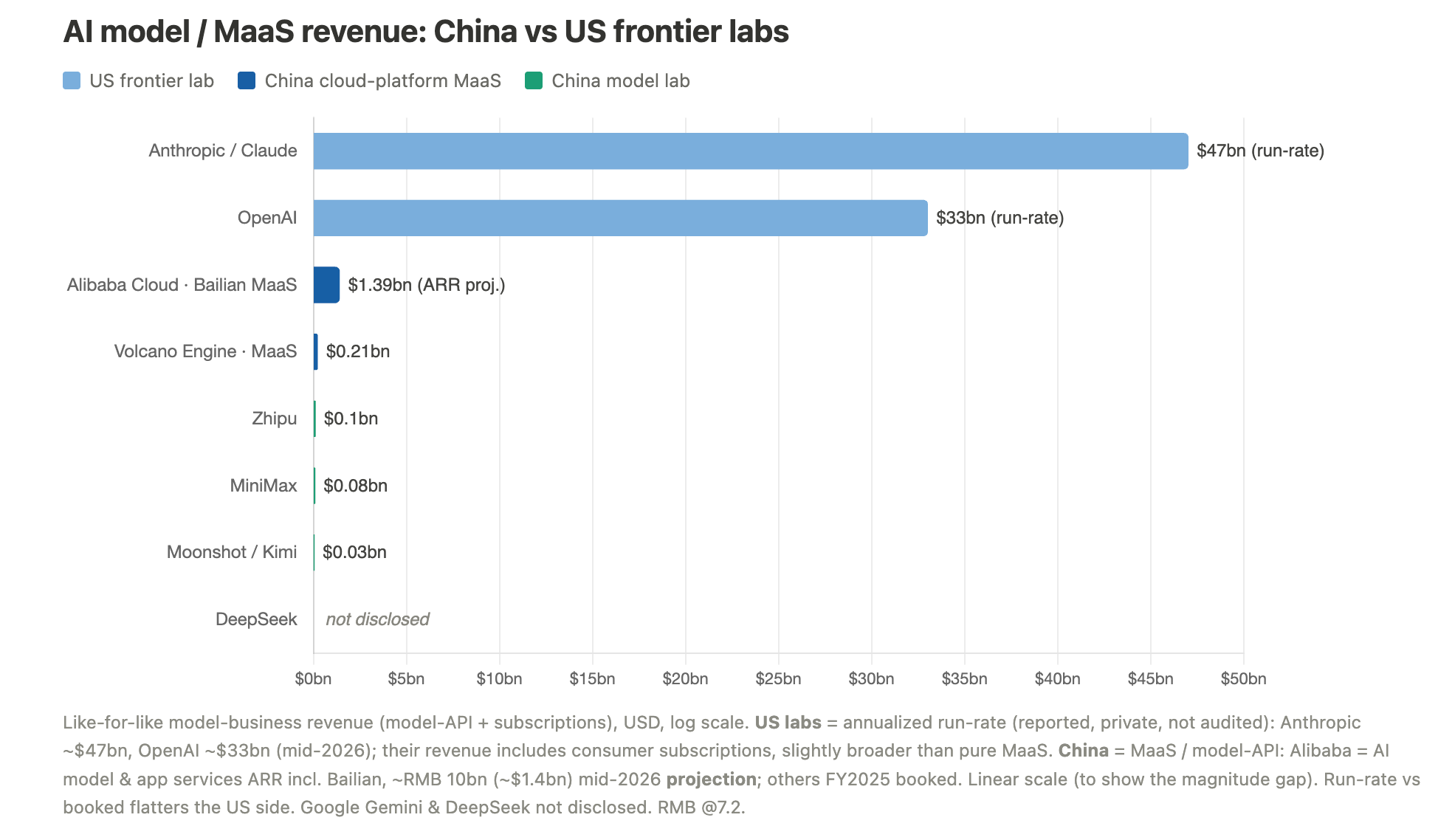
In terms of current revenue US frontier labs are operating at a scale roughly 30× Alibaba's MaaS business and over 1,000× the standalone Chinese labs (see below).
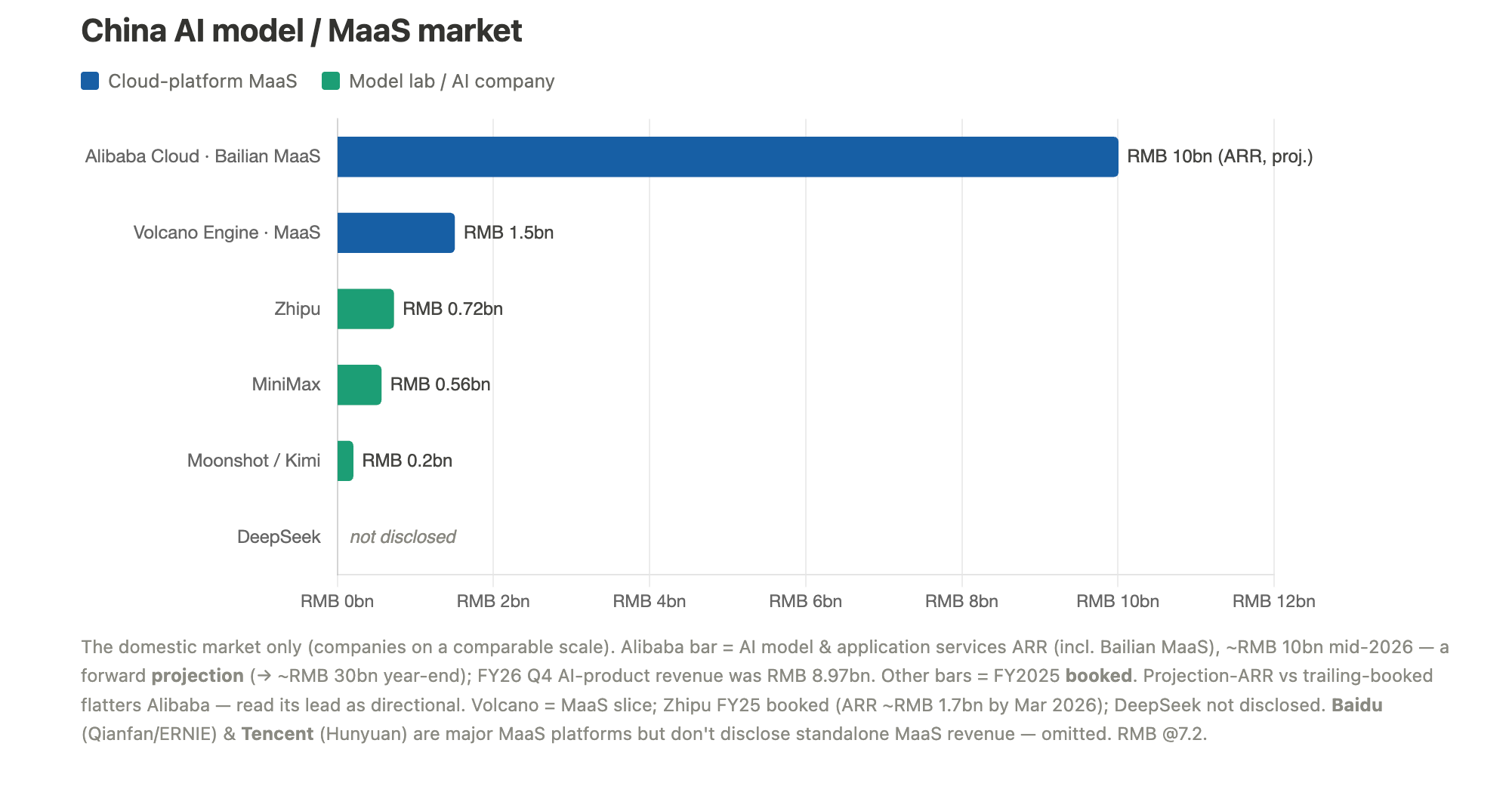
Within China, Alibaba is the clear leader in current AI MaaS revenue, with Bytedance’s Volcano in second. (see below).
The term neijuan “involution” has become widely used to describe China’s hyper-competetive business environment that can spawn innovations but also has led to price wars that bring profit margins down. For example, despite the successes of China’s EV industry, many analysts expect significant consolidation in the number of EV firms in the coming years. However, already we see a firm like iFlytek (科大讯飞)which bundles its AI-powered voice recognition software into a diverse suite of hardware products like AI note taking tablets, voice transcription and translation software gaining a larger revenue than any of China’s LLMs and even larger than former darling SenseTime. I personally bought one of iFlytek’s handy transcription devices for transcribing Chinese-language interviews. They even come with ability to detect dialects—Sichuanese, Cantonese, and even Hebei dialect!
Will the same dynamics of “involution” also extend to the AI industry? In other words, will we see rapid innovation in AI application in China alongside falling profit rates for companies involved? Leading tech firms (Ali, Bytedance, Tencent, Baidu) have strong business moats from their hold on key sectors in China. Tencent has been trying to figure out how to integrate AI into its super app Wechat 微信, which is central to life in China. Alibaba, which has a strong position in e-commerce through Taobao, Tmall, and finance, is infusing AI into its existing services, as Grace Shao has noted.7 If this is the case, then AI will help existing platform giants deepen their hold on key sectors. Meanwhile, there are newer AI-native cloud providers like Bytedance’s Volcano 火山引擎, through which ByteDance offers its Doubao LLMs—including the flagship Doubao 2.1Pro. The suite also features advanced multimodal, video generation models like Seeddance (capable of native 4K video generation and 30-second clips), and audio tools. Alibaba released its “Wukong” 悟空 agentic enterprise Ai platform in March 2026.
Then there is the question of Chinese firms going global to get beyond the fierce competition within China. Many Chinese AI firms want to go global immediately, despite the huge size of the domestic market because margins overseas are higher. An employee at an AI video generation APP in Beijing told me 30% of their revenue is coming from North America, with a popular function that allowed users to turn themselves into memes resulting in a popular “put yourself next to Jesus” meme in the U.S. and Europe. So much for Xi Jinping thought on that one!
In terms of actual revenue, a web-based scraping of recent data from corporate reports and news filings suggest that chips firms and those selling actual products are seeing much more current revenue than any of the foundation model companies, despite the leading model companies having sky high valuations. Its possible that the low trust issues discussed here are not a real hindrance to AI innovation in China. China is implementing AI with a ferocity unrivaled anywhere. But who will capture the value from China’s AI economy? There’s the rub! One possibility is that over time a lack of secure revenue for leading cloud providers and/or AI model providers results in a fierce“neijuan-style” competition that the ongoing R&D and investment needed to sustain model development. Of course, the massive amounts of Capex spending by U.S. cloud and AI firms also raises serious questions about the speculative nature of AI in general and the future profitability of U.S. Ai firms, too. China’s national funds and investment vehicles will be more than happy to sustain investment in AI research over the coming years.
China’s AI landscape has importance differences from the U.S., including a preference for open source and industrial diffusion that may offer real long-term advantages. But its also important to be “clear eyed” about the actually existing dynamics of China’s commercial landscape that shape these differences, and will continue to shape the pace and trajectory of AI adoption in China and indeed, the world.
https://www.index.dev/blog/chinese-open-source-ai-models-statistics
The emergence of Deep Seek also had little to do with direct state support-its founder had a background in algorithmic (quant) financial trading in Hangzhou.

https://merics.org/en/comment/china-activates-data-national-interest
Tongyu, Wu. 2026. “When Big Tech Needed Mothers in Rural China to Train AI” Sixth Tone. https://www.sixthtone.com/news/1018460
https://bernardmarr.com/meet-the-worlds-most-valuable-ai-startup-chinas-sensetime/

Super article! Well researched and revealing, thanks